
Mastering Behavioral Interviews in 2026: An Updated Roadmap
Get early access to the book!

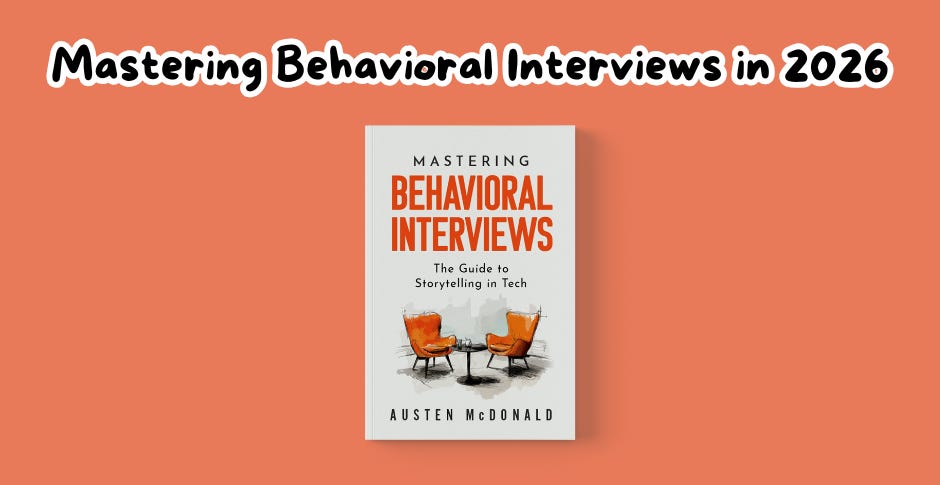
After two years of writing, coaching hundreds of candidates, and distilling a decade of experience as a Meta Hiring Committee Chair, I’m excited to announce that Mastering Behavioral Interviews is now available at a special introductory price just for two weeks!
Just in the couple of days since I submitted the book to Amazon, it is already the #3 best-seller in the Job Interviewing category, right behind…you guessed it, System Design Interview and Cracking the Coding Interview.

But more than just announcing the book, I want to give you something immediately useful: an updated roadmap for how to actually prepare for behavioral interviews in 2026….
Most tech candidates still approach behavioral prep the wrong way. They either wing it (”I’ll just be myself”), practice random questions they find online, or read about the STAR format and think they’re erady. None of these approaches work at the companies and for the roles that matter most.
Let me walk you through what actually works.
What’s Really Happening in a Behavioral Interview
In a behavioral interview, the interviewer is forecasting your future performance based on your past behaviors. They’re assessing specific competencies: Scope, Ownership, Ambiguity, Perseverance, Conflict Resolution, Growth, Communication, and Leadership.
Every question maps to one or more of these signal areas or a specific company value they’ve identified. “Tell me about your most impactful project” assesses Scope and Ownership. “Tell me about a time you disagreed with your manager” evaluates Conflict Resolution, Communication, and Scope.
Understanding this structure transforms how you prepare. Instead of trying to memorize answers to 100 possible questions, you build a strategic story catalog that covers all the signal areas they’re actually assessing.
What You Actually Need to Be Ready
After coaching over 200 candidates into FAANG+ roles, I’ve learned that successful preparation comes down to mastering a simple framework:
Decode what the interviewer is really asking
Select the right story from your experience
Deliver it in a compelling way
To do this effectively, you need four specific components:
1. Core Stories (Your Foundation)
You need 3-4 substantial project stories that represent your strongest work. Choose them based on this criteria:
Scope: Does the project demonstrate complexity appropriate for your target level? A staff engineer needs stories about driving multi-team initiatives, not just shipping a feature.
Impact: Did it move meaningful business metrics? “Reduced latency” is nice, but “reduced checkout abandonment by 15%, recovering $2M annually” establishes a real connection to outcomes.
Your Role: Were you the primary driver, or just a participant? They’re hiring you, not your entire previous team.
For each core story, you need to extract the details that matter: the business context that explains why it mattered, your specific actions (not just “I built the feature” but the decisions you made, the alternatives you considered, how you navigated challenges), the quantifiable results, and most importantly—what you learned.
This is where most candidates struggle. They know they “led a migration” but can’t articulate the 15 specific actions they took that made it successful.
In the book, I walk through the progressive journaling technique that helps you excavate these details from your memory, even for projects from years ago.
2. Additional Stories (Your Coverage)
Your core stories might demonstrate Scope and Ownership, but what about Conflict Resolution? Growth? Communication across functions?
You need 5-7 additional stories that fill the gaps in your signal area coverage. These don’t need to be as polished or as impressive as your core stories, but you need them readily accessible when an interviewer asks about a time you:
Navigated a difficult stakeholder relationship
Made a mistake and learned from it
Had to work with incomplete information
Received hard feedback and adapted
Most candidates don’t realize they have these stories until they do the structured reflection work. That time you pushed back on a product decision? That’s a Conflict Resolution story demonstrating judgment and communication. The feature that initially failed but you learned from? That’s Growth signal that senior candidates especially need to demonstrate.
3. The Big Three Questions (Your Anchors)
Three questions appear in virtually every behavioral interview loop:
“Tell me about yourself” is your chance to control the narrative. You have two minutes to frame your career trajectory, highlight 2-3 key accomplishments, and position yourself for the role. Most candidates either give a tedious chronological history or a vague summary. Instead, you want a practiced TMAY (Tell Me About Yourself) that’s tight, relevant, and sets up the stories you want to tell.
“Tell me about your most impactful project” (or favorite project, or first project you discuss) is your opportunity to showcase your best work. This story should demonstrate multiple signal areas and match your target level’s expectations. For senior+ candidates, this means organizing it with what I call the Table of Contents technique—structuring your narrative into clear themes so the interviewer can follow your complex project without getting lost.
“Tell me about a conflict” is where many candidates stumble, especially those from non-Big-Tech backgrounds. Tech companies expect you to embrace productive conflict, address disagreements directly, and use data to drive resolution. If your conflict story involves escalating to management or avoiding the difficult conversation, that’s a red flag. The book has an entire section on how tech companies view conflict differently and how to frame your stories accordingly.
These three questions take up 15-20 minutes of most behavioral interviews. If you nail them, you’re already in strong position.
4. Practice (Your Insurance Policy)
You can have great stories and still bomb the interview if you can’t deliver them clearly under pressure. The cognitive load of real-time storytelling—selecting details, organizing coherently, adapting to follow-up questions—is significant.
I recommend a progressive practice approach:
Solo practice first: Record yourself telling each core story. Watch for pacing, clarity of ownership, verbal fillers, and organization. Do this 3-5 times per story until it feels natural.
AI practice second: Use LLMs to generate unpredictable questions and test your ability to quickly pair questions with the right stories from your catalog.
Peer mocks third: Practice with friends or colleagues who can interrupt with follow-ups and provide feedback on how you’re coming across.
Professional mocks last: Get calibration from experienced interviewers who can tell you whether your stories hit the right scope and signal for your target level.
Most candidates skip practice entirely or do one mock interview the day before. That’s not enough. The difference between “good enough” preparation and “confident” preparation is usually 6-8 hours of focused practice.
Adapting to Big Tech (The Final Layer)
If you’re targeting FAANG+, there’s one more layer: understanding how to translate your experience into Big Tech language and expectations.
Coming from a startup or traditional enterprise? Your stories might need reframing. Big Tech interviewers pattern-match against specific cultural archetypes who ownership, moves fast, embrace conflict, and frame work in terms of systemic impact.
Instead of “My manager assigned me this feature,” say “I took on this feature.” Instead of “We improved the deployment process,” say “I reduced deployment time from 2 hours to 15 minutes, saving our 20-person engineering team 40 hours monthly.” The actions are the same, but the framing demonstrates the ownership and impact-orientation that Big Tech values.
Getting Started
This roadmap gives you the structure. The book goes deep on each of these steps—complete with examples at different career levels, common pitfalls to avoid, advanced techniques like the Menu Technique and Table of Contents approach, and specific guidance for specialized interview types like leadership rounds and cross-functional interviews.
If you’ve found value in this newsletter over the past year, I have a favor to ask: grab the book and leave an honest review on Amazon. Reviews genuinely help other candidates discover this resource, and after two years of work distilling everything I know about behavioral interviews, I want this to reach everyone who needs it.
The behavioral interview determines who gets the roles that matter most. With the right preparation, you can walk into any behavioral interview—at any company, at any level—knowing exactly what they’re assessing and how to demonstrate it clearly.

I've been following your substack for over a year now. It is what helped me land my position at my current company. Purchased this book, as I'm sure there are many helpful insights that I have not read.
One thing I found particularly striking in one of your videos / blogs, is that behavioral interview is something that makes you better as an engineer through its preparation. This mindset really elevated how I think about it, and my career in general.
Kudos, and thank you.
Just purchased for Kindle!