

🙋♂️ Hi there, I’m Austen, a former Senior Engineering Manager and Hiring Committee Chair at Meta where I did over 1,000 interviews and trained 100s of interviewers. I work with candidates 1:1 to help them rock their behavioral rounds at top companies. If you’re targeting Anthropic, OpenAI, or other big tech companies, check out my coaching page. And grab a copy of my best-selling book Mastering Behavioral Interviews to get a complete prep system.
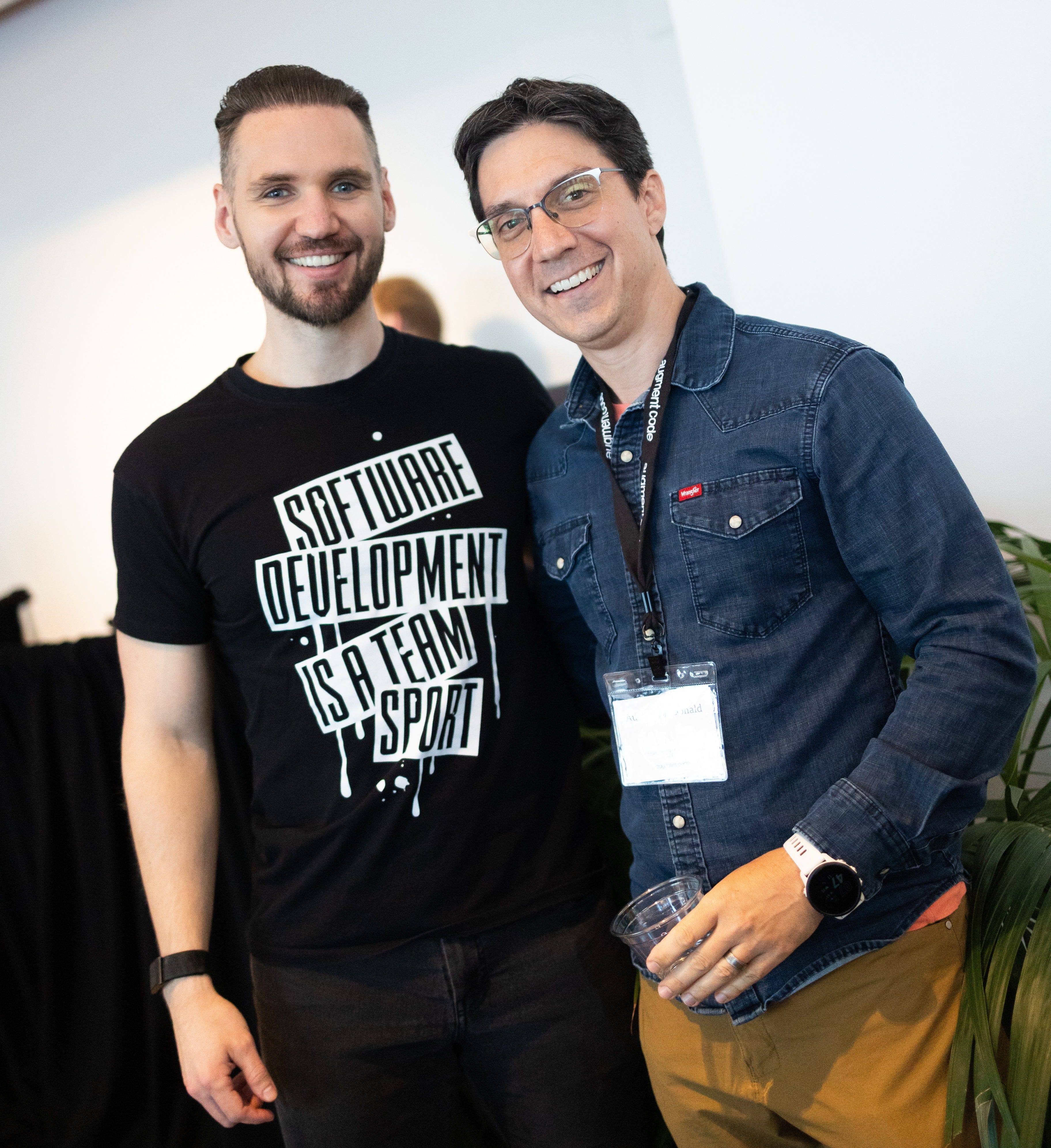
Recently, I got a chance to attend a Silicon Valley meetup and tech talk hosted by Gregor Ojstersek and Augment Code. It was classic San Francisco: a posh spot in the Ferry Building overlooking the Bay, charcuterie boards, some geeky presentations, and a bunch of somewhat shy people talking about coding with AI.
I felt nervous going in, as I always do with these things, but came out with a bunch of new contacts.
If you’re prepping for behaviorals, you’re probably networking to find open roles as well. Let me tell you about how I’ve gone from one of the most insecure wallflowers to someone the organizer of that meetup says is (apparently) an expert networker:

First, Change Your Mindset
All your actions come from within, borne of your beliefs. If you want to be a great networker, you have to start by establishing the following truths, inside yourself. The tactics I discuss in the next section won’t work otherwise:
Everyone is just as uncomfortable as you are. Seriously. Even the people who look like they’re working the room (even me). Most people at meetups feel the same undercurrent of social anxiety about breaking into conversations and introducing themselves to total strangers. You’re not uniquely bad at this. You just haven’t figured out how to overcome it yet.
Everyone wants to talk to you. This is a significant difference between meetups and other social situations. At a bar or a party, people might or might not want to be approached and your brain is cautious about potential rejection. At a tech meetup, everyone showed up explicitly to network. That’s why they’re there. Ok fine, there’s often a talk of some kind, but the talk is not really the point. This means you don’t need to earn your way into a conversation and you’re very unlikely to be rejected.
Relationships make life worth living. Not to get too philosophical but you’ve probably figured out by now that good relationships are a key to having a good life. Decide that meeting new people makes your life richer and fuller and that will make you genuinely interested in the strangers you’re about to encounter.
Meditate on these things. You know they are true. Let them change you from the inside.
On to Tactics...
If you struggle meeting people at these kinds of events, and you’ve internalized the three above mindset shifts, let me give you a set of tactics that work for me, roughly ordered from (socially) easiest to hardest.
Take a wingman
Going it alone is always harder than bringing a friend. If you have the opportunity, get a friend to go with you to the event. You’ll feel so much more at ease with at least one friendly face there. If things get overwhelming, you can always seek out your friend for a respite.
The risk will be that you end up talking to each other all night. Agree to apply some of the other tactics I discuss below, separately, and then come back together and introduce each other to the new folks you’ve met.
Come in with a plan
Before you go to an event, prepare two or three conversation-starter questions. Something like:
“How are you leveraging AI in your current role?”
“What do you want to get from being here?”
“What’s your take on (topic the meetup is about)?”
Even though I’m not a journalist and I’m not going to curate what I hear, it’s almost like I’m doing research on the room and somehow that helps me see purpose and meaning in talking with total strangers.
Use downtime
One of the easiest places to start a conversation is somewhere you’re already stuck waiting—the food line or sitting in the rows right before the presentation.
You and the stranger are both just waiting there.
In silence.
How boring for both of you.
You’re not interrupting anything if you talk with them. Just say hi and introduce yourself. It works because it’s low stakes. Again, they came to this event to connect with people. They won’t mind.
Leverage familiar faces
If you’ve managed to talk to a few people, or you brought a wingman, look for those familiar faces in conversation pods of other people. It should be easier for you to go up and join their conversation when you know you’ll be introduced by this familiar person.
Obviously, this presents an exponential growth opportunity for you to connect with new combinations of people.
Move around the room
While I was at this meetup in SF, I saw a forlorn individual, standing at one of the tables off to the side, just eating the snacks. For like 20 minutes. Clearly they wanted to meet people—I mean, they could have just left—but didn’t have skills to do so. I regret not saving this person and if you’re out there reading this, I’m sorry.
But if you go to these meetups, you do need to move around the room. Go get a snack. Go move to a different table. Go to the bathroom. Even just walk around between the groups of people. As you move around you’ll find opportunities to apply one of the other tactics.
If you stay put and wait for people to come to you, it may never happen.
There’s a corollary to this, which is that just because you’ve found a few people to talk to, don’t talk to them the whole night. It’s comfortable and you won’t have to overcome the social friction of meeting new people but that’s not your goal.
Be happy and curious
In these meetings with strangers, people have only the most raw social cues to consume. They don’t know you, your personality, or that you’re really a nice person inside. They are simply judging you by the look on your face and your body language. If you want people to talk to you, put an amicable look on your face. Smile.
Also, it was good advice when your mom gave it to you before that big Prom date and it’s good advice now: people just want to talk about themselves. Once a conversation starts, ask questions about them. You’ll come across as genuinely curious (because you should be), and you’ll make the other person feel good about the conversation. Ask follow-up questions. Let them go deep on something if they want to.
Prey on newcomers
I did this at a different meeting recently in SF: post up near the entrance and talk to some people as they come in. First, they obviously aren’t talking to anyone yet. Second, they are probably super nervous, just like you were when you walked in, and will be grateful for someone who’s enthusiastic about meeting them.
At this other meetup I mentioned, I did this probably too obviously, to the point where people started asking me, “Do you work for (sponsoring company)?” lol
Just walk up and stand next to a group
Ok, here we go, probably the hardest but most effective tactic to employ. Find a group of three or more people, walk up, and stand near them. Give it a moment. They will almost always shift to include you.
People at meetups are doing this constantly. Nobody is trying to form an impenetrable circle. When someone walks up, the natural instinct is to open the group. Trust that it will happen.
Boom, now you’ve met three new people.
A Note on Talking to the Speakers/Organizers
At most meetups, there are one or two featured speakers or guests—the principals who gave the talk, ran the panel, or are there in some official capacity. These people are worth talking to, and many attendees are too intimidated to approach them.
A few things that work:
Have a specific question ready. Not a generic “great talk” comment since that doesn’t go anywhere. Prepare something that shows you actually engaged with what they said, or something that’s relevant to their work. “You mentioned X — I’ve been thinking about that in the context of Y, what’s your take?” That kind of thing opens a real conversation.
Don’t linger too long. Principals have a lot of people who want their time. Have your conversation, get what you came for, and move on. Don’t monopolize. They’ll remember you better for being efficient and respectful.
Ask to connect on LinkedIn before you leave. The worst they can say is no. Send them a request later with a message that references your conversation.
And don’t be afraid to walk up. They can probably leave anytime they want so if they’re still there, they still want to talk to people. Don’t talk yourself out of approaching because it feels presumptuous. It isn’t.
These events are worth going to. Your next role will probably come from someone you know so get out there actually know some people.
It can be challenging. I get it, it’s challenging for me too. But it does get easier, and the rewards—new connections, job leads, the occasional collaboration that you couldn’t have predicted—will come.
Like what you’re reading? Subscribe below for posts about behavioral interview prep and landing roles at top tech companies, from me, a former Meta hiring committee chair and Senior Engineering Manager.
Great summary of networking! From my experience I'd tweak statement that all people that came to an event want to network. I'd say a kind of 10% are active networkers, 70% are ok to network, 20% are just came there (maybe want to network, maybe not, not in the mood today, not clear sometimes even for them).
And it is better to focus on the first 2 groups – not trying to 'save' some guy standing alone for 20 minutes (if you are not an organizer or some sort of official facilitator at the event).
Probably the last cornerstone technique for such events to add to the playbook is how to end a conversation nicely - not to be stuck for the whole evening with just one person (though it is very tempting and safe for you and your counterpart and all of us do not like stop conversations).
Something like 'It was nice talking to you, I'd... grab a beer, ask a speaker, check who is also around'
For LinkedIn connections using QR codes works much smoother than trying to spell somebody's full name.
And if I were summarizing this article for one simple thing you can do today to be better in tech networking – learn the 3 conversation starting questions, they are person-oriented and open-ended.